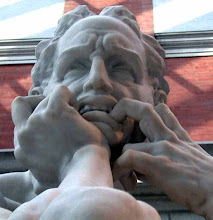
STRUCTURE
People sometimes tell me I’m a "people person." I laugh to myself whenever they do. I understand their reasons for saying so. I can be garrulous. But they don’t know how things really run inside of me. There are different levels inside of me. When I say I am a structured person, I don’t mean that I do things in an orderly manner. No. When I use the word structure in this way, I am referring to a dilapidated house of wooden crates and planks, warped and molded and glued together, melded by twisted, rusty nails, oversized bolts. My inner rooms are an amalgamation, a ramshackle clubhouse where people hide inside whatever room they choose.
One room is all purple, light and dark, and there are bowls filled with little bits of paper laced with drugs. These bowls are placed politely on doilied tabletops as if they held sweet candies wrapped in cellophanes. There are windows in that room, and trees outside, a park where children laugh and cry and shout.
In another room there is no light. This is where the half-people gravitate, those half-people whose transitional floors gave way too soon, planks crumbling beneath their feet before they had time to cross from adolescence to adulthood. So they fall into that gap, one that opens somewhere between a pimpled, glad invisibility and the somber space below, a dark space where they land, bodies thumping, among the shriveled skins of dried up selves piled around the room like buffalo hides.
There are rooms where people die too early and others die too late. Rooms full of sadists and idealists. Rooms where pretending never stops. Most pleasant are the kitchens, or the rooms with the overstuffed chairs. Some have greeting spaces and staircases. I have built this house inside of me.
It seems that I’m involved in something new, though nothing yet is clear. One thing not yet clear is whether this flimsy house will be demolished, or if I’m only adding on another room. There are levels here where what you see is seemingly what you get. And there remain too, sublunary hiding spaces where people (people like me at least) really live. For a long time I’ve been thinking that once a room is built, it’s built.
I’ve been trying to exercise too. It’s not my nature. I’m doing it because the world "out there" requires physical continuity. I’ve never been physical. When I was a child I could not run fast, could not skate gracefully. I lacked balance. Others seemed born with it.
When I was capable of real sleep, I’d have this recurring series of dreams based on real-life events. The dreams are set in the same summer I learned to ride a bicycle. My father had rented us a bungalow near the beach. That summer stays with me even without dreams. I’d fish for minnows in the bay. I'd stuff bread inside a milk bottle that I’d sink, a rope tied round its slender neck. Fat minnows swam in after the bread and I’d pull the bottle in. I discovered places crickets lived, in a nearby vacant lot, all sandy dirt and rocks, tall grasses clumped around.
One morning I walked up on a yellowish ball of larvae swarming alongside the body of a grasshopper who’d been nicked by the tire of a passing car. Apparently, her pregnant belly had popped. There they were, her squirming babies baking on warm tar. I killed a praying mantis too, behind the house that summer, just because. I hear talk about alcoholic behavior. I sometimes wonder if that’s the kind of thing that’s meant.
* * *
In place of sleep comes gravity; gravity and an unqualifiable peace—both fill the air I breathe, here in my bed, sober, detached. And as I put some sober days together I am finding this truth, that the more I let go the more I tap some hidden and sustaining principle. It’s as if when I do my part, taking care of what’s in a day, tilling the garden as it were, of my own hidden life, then whatever it is that’s out there smiles on me; not in a way that “honors” my daily endeavors because I deserve a reward or something—no, more in a way that these two operating principles, letting go and empowerment, simply resonate with one another. At Melrose House they say: “Just do the next right thing.” Not easy for a putz like me, but I’ve been trying it on for size and well, so far so good.
When, at night, I lie in bed I think about the day. That Monday’s instructors conference, or how far I walked, how many bars I counted (Seventeen. This is a college town for sure). I think about writing again, and my first class. My first class; I must admit it went well. Imagine my surprise when she walked in. Her hair was up, and she wore a flowered dress. Stunning really. I held my breath. I’ve got a good poker face.
And her dog—no one in the room batted an eye. Apparently she takes it everywhere she goes, that enormous, broadly muscled beast. Her silences. I’m unsure which is more ominous, the dog or the quiet that surrounds her. Everyone in class but me seemed to already know: she cannot speak.
“Have you ever felt really empty?” She handed me that note a few nights back. I had not recognized them then: the first six words of my first and only book. She’s a fan. How Glea would laugh at that notion. Maybe not. Glea’s the one that got me here after all.
I’m the one who can’t believe I still have fans, but in fact, ninety-nine percent of my student’s are there because they loved the book. My book. I don’t want to screw this up. God, please, don’t let me screw this up. “Let go. Let God,” they say at Melrose House. I close my eyes. Something near to sleep arrives. Gravity. It is quiet.
Showing posts with label alcohol. Show all posts
Showing posts with label alcohol. Show all posts
Thursday, May 29, 2008


Tuesday, January 15, 2008
This Magic Moment
Wine
Sometimes, they say, you can taste chocolate in the wine, pepper, eucalyptus. Critics suggest wine has "structure." Nonsense. Not to say some wines aren't a bit like turpentine while others flow like silk, but after a bottle (or two or three) why would a palette care one bit? It does not take long for the head to turn to effusion and whimsy. Whenever I drink wine I taste something broken: bone, blood, steel. The wine I drink has teeth in it—my own.
Yes, I know, the accident again. It is always with me, even when I don't notice it until, turning, I catch my reflection in a shop window, or until a certain slant of sun reminds me that all of life is a Nothing's short reprieve—no more, no less.
More than one person has asked, "Did you see a light when it happened?" Emphatically I tell all of them no. No, I say. There was no light at the end of a long tunnel. Nor did I see my own face laughing at any point, my boy-body riding on a park swing at four or five, or myself all pimply faced and a shy high school freshman, a first kiss, a fight with my father. My life did not flash before me. "That's a bad sign," at least one person has informed me.
What I knew at the moment when my face was actually being destroyed, the only thing I knew, was "the real," which I have ever since believed has its own significant power. Nature. Life yes. Death yes. Yes, when the corner of a concrete slab busted through my car window, me suspended upside down, the car overturned and spinning, and when that slab, overcoming the shield of my flailing hands, my arms, as it momentously began to purée (I heard the bones cracking) my cheeks, the only thing offered me was an obliteration not to be denied which, in and of itself, once come, was not as bad as it sounds. Black I tell them, is what I saw. Nothing the thing I experienced first hand. I surrendered. I was overcome. Lights out.
Obviously, I survived. And when I hear this spurious talk of wine, these are the things I think. An empty bottle weighs twice as much as when it had been full. It is filled instead with craving and consequence, with shame and despondency. Someone has said, "Live the life you have imagined." What happens when you look around to see that all the rot and poppycock of your life is in fact the life you have imagined, the one you have built, the one for which you alone are responsible?
* * * * *
The early morning sun was high and bright. Iowa in August is nothing if not hot. "Sorry I'm late," I said to the table full of strangers, a cafeteria-sized room so brimming with light that it washed out the color of the walls. A woman wearing a nametag (I hesitatingly clipped mine on), well spoken, well-dressed—also drenched in light—welcomed everyone, raised excited and expectant hopes for the week. She gestured from behind a thin podium at the front of the room. The sound system recast her voice in metallic, muffled airs.
There were tables all around just like ours, circled with men and women, nametags matching little folded cards on napkins. The man to my left scooted his chair over to let me in. I was dripping. I clipped my nametag to my sweaty shirt and smiled nervously, a little absently even. My thoughts were elsewhere.
I had noticed some curious structures as I walked along my chosen route—hexagonal frames of metal-sheathed, glass-paneled domes, modest semi-circular buildings set like giant buckyballs here and there around the campus lawns, all made of glass. Inside each one, visible at their centers, stood a vertical firebrand, a dark post with a flame on top. I imagined them the red eyes of leviathans peering out of time. Each structure looked identical, fragile, insubstantial.
"Those are the Author's Houses," the man I sat next to told me after the Instructor Orientation had ended. "The few fortunate students admitted to the university are each assigned a house. It's where they'll write their stories. We are very lucky to be here," he said with conviction. His nametag said Bill. "Thanks Bill," I said.
Drawing a handkerchief from my pocket, I patted my brow and turned to my right where an attractive, modestly dressed woman was sipping a glass of water. Her name was Gladys, and I learned she and her husband had moved to Ellenville from New Jersey. "There's an inherent goodness here," she said, nodding, smiling. I did not know how to react to any of it, the orientation, the Author's Houses, inherent goodness. I asked for directions to the men's room and excused myself.
These Author's Houses, as my tablemates had called them, did not appeal to me. Too symmetrical. Too something. Lovely in a decorative kind of way, perhaps. But I thought, looking at myself in the bathroom mirror, give me monsters that burn and howl, not these burnished domes of glass. Small blessing: they'd remain vacant for the summer, save for the red flicker of a dragon's eye in each.
Stepping outside, I once again felt the heat of the sun beat hard against my frame. No matter. I had another meeting to attend, at The Melrose Group. I thought it a simple twelve-step meeting place, but its compass was broader than that. Before the week was up I'd learn that Melrose was actually a halfway house for people struggling with feeling problems of every kind, a self-proclaimed nut house (how they'd laugh about that).
Still, as I had not yet been alerted to that fact, I sat, calmly watching an old man the color of putty scoot his chair in and out under the wooden, candle-lit table that ran the entire length of the room. An incessant tick rippled his cheek just beneath his right eye. A girl with garish blue hair entered carrying a guitar case. The door swung closed behind her. Others arrived, some sedate, some bent as if weighed down by something hung around their necks. A couple of others looked at me and smiled as they passed. One of them said, "Welcome." Her voice rattled like pebbles in the bottom of a coffee can. I nodded at her, attempting a smile.
Melrose House itself was old. The wood-paneled walls and faded carpet set the aged tone, along with stairs that creaked and small, framed prints hung here and there on the walls—a sunny cottage, a vase of flowers. Frayed cushioned chairs abutted low corner tables set with ashtrays. Once white curtains trimmed the windows in lacey patterns and the long wooden table at the center of everything had been set with baskets of paper flowers that were touched by the candlelight.
On the hour a bell chimed. The girl with blue hair read a preamble. A few introductory remarks were spoken by another person, a man in work clothes, his brown hair pulled back behind his ears. Other people around the room took turns sharing. When my turn came I simply introduced myself as an out of towner, grateful to have found a place to come and spend a little time. "I did not have a drink today," I said.
"Hi Michael," several of them responded in unison. "Welcome." The man with the tick on the right side of his face clapped his hands together.
At the end of the meeting everyone stood. We held hands and said a prayer. When we finished, the fellow with the work clothes looked up. "I love this program," he said. "Since I've been coming I've remembered how to screw." A few of us laughed.
"I'm coming back to this group," I said aloud, and more laughter erupted. The old man with the tick clapped his hands.
That night I said a prayer. But, It wasn't the kind of prayer you think of when you think about prayer. No. This prayer was not capable of being spoken. I was out of words. And, even if I wasn't out of them, words seemed somehow inadequate. Words themselves would have thought too much of that moment to stain it with their residues. Silence proved the only reverent response.
Nor was there any conscious effort on my part to pray. As best as I can tell it, I felt still. That's all. And I seemed to be setting something out, presenting something almost physical to life itself, a gift. At the same time, I was receiving something. I had no idea what. To this day I do not know.
I nearly slept that night. I lay back quietly and listened. The wind was passing outside the window. A halo of moonlight danced along my hands. I thought of Gladys's words. "There's an inherent goodness here," she had said. I thought, too, about my parents, my brother and my sisters, when we were all very young. Here it seemed my life did flash before me.
Sweeter than wine, I thought. A long time passed before I could say anything. Then words came. "Thank you," I said out loud. I whispered it more than once. "Thank you. Thank you."
Sometimes, they say, you can taste chocolate in the wine, pepper, eucalyptus. Critics suggest wine has "structure." Nonsense. Not to say some wines aren't a bit like turpentine while others flow like silk, but after a bottle (or two or three) why would a palette care one bit? It does not take long for the head to turn to effusion and whimsy. Whenever I drink wine I taste something broken: bone, blood, steel. The wine I drink has teeth in it—my own.
Yes, I know, the accident again. It is always with me, even when I don't notice it until, turning, I catch my reflection in a shop window, or until a certain slant of sun reminds me that all of life is a Nothing's short reprieve—no more, no less.
More than one person has asked, "Did you see a light when it happened?" Emphatically I tell all of them no. No, I say. There was no light at the end of a long tunnel. Nor did I see my own face laughing at any point, my boy-body riding on a park swing at four or five, or myself all pimply faced and a shy high school freshman, a first kiss, a fight with my father. My life did not flash before me. "That's a bad sign," at least one person has informed me.
What I knew at the moment when my face was actually being destroyed, the only thing I knew, was "the real," which I have ever since believed has its own significant power. Nature. Life yes. Death yes. Yes, when the corner of a concrete slab busted through my car window, me suspended upside down, the car overturned and spinning, and when that slab, overcoming the shield of my flailing hands, my arms, as it momentously began to purée (I heard the bones cracking) my cheeks, the only thing offered me was an obliteration not to be denied which, in and of itself, once come, was not as bad as it sounds. Black I tell them, is what I saw. Nothing the thing I experienced first hand. I surrendered. I was overcome. Lights out.
Obviously, I survived. And when I hear this spurious talk of wine, these are the things I think. An empty bottle weighs twice as much as when it had been full. It is filled instead with craving and consequence, with shame and despondency. Someone has said, "Live the life you have imagined." What happens when you look around to see that all the rot and poppycock of your life is in fact the life you have imagined, the one you have built, the one for which you alone are responsible?
* * * * *
The early morning sun was high and bright. Iowa in August is nothing if not hot. "Sorry I'm late," I said to the table full of strangers, a cafeteria-sized room so brimming with light that it washed out the color of the walls. A woman wearing a nametag (I hesitatingly clipped mine on), well spoken, well-dressed—also drenched in light—welcomed everyone, raised excited and expectant hopes for the week. She gestured from behind a thin podium at the front of the room. The sound system recast her voice in metallic, muffled airs.
There were tables all around just like ours, circled with men and women, nametags matching little folded cards on napkins. The man to my left scooted his chair over to let me in. I was dripping. I clipped my nametag to my sweaty shirt and smiled nervously, a little absently even. My thoughts were elsewhere.
I had noticed some curious structures as I walked along my chosen route—hexagonal frames of metal-sheathed, glass-paneled domes, modest semi-circular buildings set like giant buckyballs here and there around the campus lawns, all made of glass. Inside each one, visible at their centers, stood a vertical firebrand, a dark post with a flame on top. I imagined them the red eyes of leviathans peering out of time. Each structure looked identical, fragile, insubstantial.
"Those are the Author's Houses," the man I sat next to told me after the Instructor Orientation had ended. "The few fortunate students admitted to the university are each assigned a house. It's where they'll write their stories. We are very lucky to be here," he said with conviction. His nametag said Bill. "Thanks Bill," I said.
Drawing a handkerchief from my pocket, I patted my brow and turned to my right where an attractive, modestly dressed woman was sipping a glass of water. Her name was Gladys, and I learned she and her husband had moved to Ellenville from New Jersey. "There's an inherent goodness here," she said, nodding, smiling. I did not know how to react to any of it, the orientation, the Author's Houses, inherent goodness. I asked for directions to the men's room and excused myself.
These Author's Houses, as my tablemates had called them, did not appeal to me. Too symmetrical. Too something. Lovely in a decorative kind of way, perhaps. But I thought, looking at myself in the bathroom mirror, give me monsters that burn and howl, not these burnished domes of glass. Small blessing: they'd remain vacant for the summer, save for the red flicker of a dragon's eye in each.
Stepping outside, I once again felt the heat of the sun beat hard against my frame. No matter. I had another meeting to attend, at The Melrose Group. I thought it a simple twelve-step meeting place, but its compass was broader than that. Before the week was up I'd learn that Melrose was actually a halfway house for people struggling with feeling problems of every kind, a self-proclaimed nut house (how they'd laugh about that).
Still, as I had not yet been alerted to that fact, I sat, calmly watching an old man the color of putty scoot his chair in and out under the wooden, candle-lit table that ran the entire length of the room. An incessant tick rippled his cheek just beneath his right eye. A girl with garish blue hair entered carrying a guitar case. The door swung closed behind her. Others arrived, some sedate, some bent as if weighed down by something hung around their necks. A couple of others looked at me and smiled as they passed. One of them said, "Welcome." Her voice rattled like pebbles in the bottom of a coffee can. I nodded at her, attempting a smile.
Melrose House itself was old. The wood-paneled walls and faded carpet set the aged tone, along with stairs that creaked and small, framed prints hung here and there on the walls—a sunny cottage, a vase of flowers. Frayed cushioned chairs abutted low corner tables set with ashtrays. Once white curtains trimmed the windows in lacey patterns and the long wooden table at the center of everything had been set with baskets of paper flowers that were touched by the candlelight.
On the hour a bell chimed. The girl with blue hair read a preamble. A few introductory remarks were spoken by another person, a man in work clothes, his brown hair pulled back behind his ears. Other people around the room took turns sharing. When my turn came I simply introduced myself as an out of towner, grateful to have found a place to come and spend a little time. "I did not have a drink today," I said.
"Hi Michael," several of them responded in unison. "Welcome." The man with the tick on the right side of his face clapped his hands together.
At the end of the meeting everyone stood. We held hands and said a prayer. When we finished, the fellow with the work clothes looked up. "I love this program," he said. "Since I've been coming I've remembered how to screw." A few of us laughed.
"I'm coming back to this group," I said aloud, and more laughter erupted. The old man with the tick clapped his hands.
That night I said a prayer. But, It wasn't the kind of prayer you think of when you think about prayer. No. This prayer was not capable of being spoken. I was out of words. And, even if I wasn't out of them, words seemed somehow inadequate. Words themselves would have thought too much of that moment to stain it with their residues. Silence proved the only reverent response.
Nor was there any conscious effort on my part to pray. As best as I can tell it, I felt still. That's all. And I seemed to be setting something out, presenting something almost physical to life itself, a gift. At the same time, I was receiving something. I had no idea what. To this day I do not know.
I nearly slept that night. I lay back quietly and listened. The wind was passing outside the window. A halo of moonlight danced along my hands. I thought of Gladys's words. "There's an inherent goodness here," she had said. I thought, too, about my parents, my brother and my sisters, when we were all very young. Here it seemed my life did flash before me.
Sweeter than wine, I thought. A long time passed before I could say anything. Then words came. "Thank you," I said out loud. I whispered it more than once. "Thank you. Thank you."
Sunday, October 07, 2007
Hello It's Me
THE CALL
I was caught off guard when I heard her voice on the phone. “How are you, Michael?” she said. “It’s Glea.”
I knew her voice, but hearing it felt alien. It sounded to me like a voice one would avoid if they could; a voice belonging to a neighbor who’s been crouching in your garden every evening at dusk, watching as you walk around your kitchen in your underwear; the person who you knew had poisoned your cat, though you could not prove it, and who called because they knew you knew but couldn't say anything about it. I couldn’t tell right then which of us was being creepy.
I responded with shortness. “Glea.”
Glea Carroll of the McNally Agency had been a great support when I was marketable. She stayed in constant contact, putting me in touch with publishers and editors, people she said she knew I’d click with. As my agent Glea facilitated many good things for me. But self interest clung to her like the smell of something burning. I was never crazy about that part of her, and now that I was no longer a hot commodity I discovered my instincts about her had been justified.
“Michael, I know I haven’t called. But I have been thinking about you.” She must have detected the blank recognition, the plain lack of response in my voice.
“I’ve been thinking about you too,” I said finally.
“I realize it’s been some time.” She spoke in clear, distinct tones.
Damn, I thought. I hoped like hell she didn’t feel sorry for me. I wanted to savor my resentment. Across the room the cat began hacking and then puked on some papers I’d laid down when the phone rang. “Goddamit,” I growled through crooked teeth.
“Is this not a good time?” Glea asked. “Should I not have called?”
“No. It’s fine,” I told her, “my cat. How have you been?”
“I’m well,” she said. Glea , always proper, never said "I'm fine," or "I'm good."
“I’m also well,” I responded flatly. “To what do I owe the honor, Glea?”
She hesitated, only momentarily, and then explained why she called. She knew I’d been in a rut since the accident. She thought she had something I might be interested in trying. “You’re not drinking?” she asked at one point.
“No, I’m not drinking,” I said. I was lying. I’d turned into a morning drinker. Mostly wine when I stayed home. Beer if I walked down to play the juke box at the Top Hat where Milna poured drafts and flaunted her huge rack behind the bar. On days when I’d stop caring altogether, often after not sleeping, I’d drive instead of walk. The accident seemed, at those times, remote. Maybe I was remote. The walls of my apartment looked pale to me. “Why do you ask, Glea?”
“I have a contact at Iowa,” she said. “Do you think you’d consider putting together a workshop for them? They’re interested in having you. I can put you in touch.”
In touch was something I hadn’t been in a while. I touched my face. “Teach what to who?” I asked.
“We can work all that out,” she said straight forwardly, as if she had all of it already planned. “You’re a name. Published. And they’re paying.”
The offer was a far cry from television interviews and book signings. I looked across the room and squinted at the stack of bills on the desk. “I could use a change,” I told her. “Iowa. How much and what do I need to do?”
“Let me make some calls,” she said, and we ended it there.
I scribbled her name on one of the refrigerator lists, then grabbed my keys. It was Friday. Milna typically wore a skirt on Fridays. She’d be working till noon.
I was caught off guard when I heard her voice on the phone. “How are you, Michael?” she said. “It’s Glea.”
I knew her voice, but hearing it felt alien. It sounded to me like a voice one would avoid if they could; a voice belonging to a neighbor who’s been crouching in your garden every evening at dusk, watching as you walk around your kitchen in your underwear; the person who you knew had poisoned your cat, though you could not prove it, and who called because they knew you knew but couldn't say anything about it. I couldn’t tell right then which of us was being creepy.
I responded with shortness. “Glea.”
Glea Carroll of the McNally Agency had been a great support when I was marketable. She stayed in constant contact, putting me in touch with publishers and editors, people she said she knew I’d click with. As my agent Glea facilitated many good things for me. But self interest clung to her like the smell of something burning. I was never crazy about that part of her, and now that I was no longer a hot commodity I discovered my instincts about her had been justified.
“Michael, I know I haven’t called. But I have been thinking about you.” She must have detected the blank recognition, the plain lack of response in my voice.
“I’ve been thinking about you too,” I said finally.
“I realize it’s been some time.” She spoke in clear, distinct tones.
Damn, I thought. I hoped like hell she didn’t feel sorry for me. I wanted to savor my resentment. Across the room the cat began hacking and then puked on some papers I’d laid down when the phone rang. “Goddamit,” I growled through crooked teeth.
“Is this not a good time?” Glea asked. “Should I not have called?”
“No. It’s fine,” I told her, “my cat. How have you been?”
“I’m well,” she said. Glea , always proper, never said "I'm fine," or "I'm good."
“I’m also well,” I responded flatly. “To what do I owe the honor, Glea?”
She hesitated, only momentarily, and then explained why she called. She knew I’d been in a rut since the accident. She thought she had something I might be interested in trying. “You’re not drinking?” she asked at one point.
“No, I’m not drinking,” I said. I was lying. I’d turned into a morning drinker. Mostly wine when I stayed home. Beer if I walked down to play the juke box at the Top Hat where Milna poured drafts and flaunted her huge rack behind the bar. On days when I’d stop caring altogether, often after not sleeping, I’d drive instead of walk. The accident seemed, at those times, remote. Maybe I was remote. The walls of my apartment looked pale to me. “Why do you ask, Glea?”
“I have a contact at Iowa,” she said. “Do you think you’d consider putting together a workshop for them? They’re interested in having you. I can put you in touch.”
In touch was something I hadn’t been in a while. I touched my face. “Teach what to who?” I asked.
“We can work all that out,” she said straight forwardly, as if she had all of it already planned. “You’re a name. Published. And they’re paying.”
The offer was a far cry from television interviews and book signings. I looked across the room and squinted at the stack of bills on the desk. “I could use a change,” I told her. “Iowa. How much and what do I need to do?”
“Let me make some calls,” she said, and we ended it there.
I scribbled her name on one of the refrigerator lists, then grabbed my keys. It was Friday. Milna typically wore a skirt on Fridays. She’d be working till noon.
Subscribe to:
Posts (Atom)